
Breaking the Cycle: Why Business Owners of Color Remain Underfunded in Beauty — and What Venture Capital Can Do About It
Despite outperforming peers, Black beauty founders continue to face systemic exclusion—rooted not in performance, but in perception, access, and structural inequity.

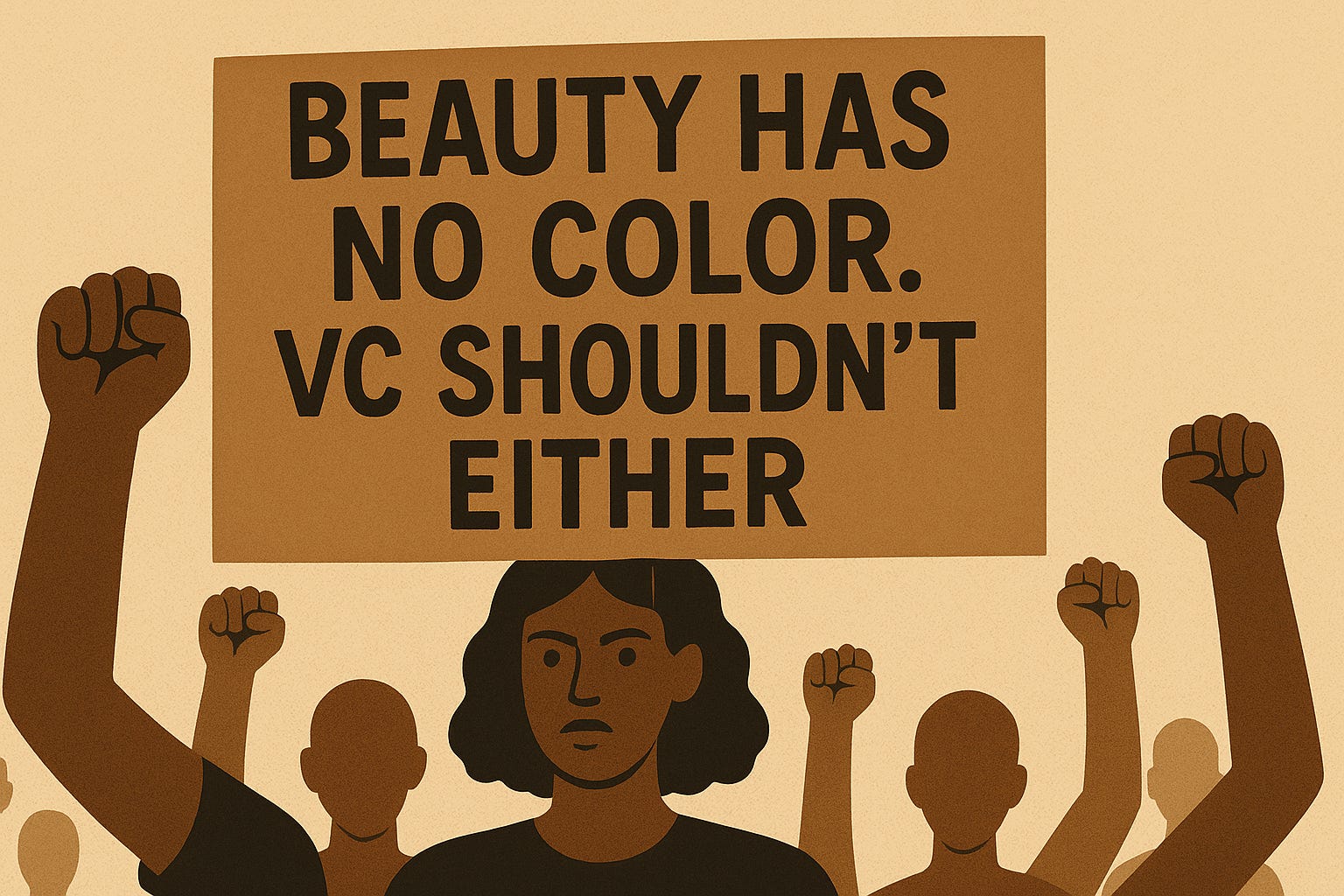
In an industry built on innovation, cultural trends, and deep consumer connection, the continued underfunding of business owners of color, particularly Black beauty founders, is not just a moral failure—it’s a strategic blind spot. Despite clear demand and strong market performance, these founders face systemic barriers that limit access to capital and opportunity, revealing a disconnect between where value is created and where investment flows. This article examines the structural barriers within the beauty industry and outlines how venture capital can take decisive action to close equity gaps, investing more intentionally in founders of color.
I. Performance Without Permission: The Growing Disparity in 2025
The undercapitalization of Black-owned beauty businesses is not new, but it’s deepening. In 2023, funding for Black-founded startups fell 71% to just $705 million, while overall U.S. VC funding declined by only 37%. This marked the first time since 2016 that funding for Black startups failed to surpass $1 billion.
Meanwhile, Black consumer spending in beauty surged to $9.4 billion, outpacing the overall industry’s growth. Across all demographics, consumers purchased $142.6 million in products from 209 Black-founded beauty and wellness brands—91% of which were led by Black women. These brands aren’t merely holding their own; they’re exceeding all expectations. In fact, a McKinsey study reports that VC-backed Black beauty brands achieved 89 times higher median revenue than their non-Black counterparts funded in the same time period, despite receiving 90% less capital.
And yet, Black consumers—who account for 11.1% of total U.S. beauty spending—see Black-owned brands capture only 2.5% of industry revenue, and just 4-7% of brands on major retail shelves. The numbers make one thing clear: this isn’t a performance gap, but a systemic failure in the inability to value and invest in the very founders driving growth and innovation.
This contradiction is intensifying in 2024 and 2025, as political backlash against DEI initiatives accelerates corporate retrenchment. Companies like Target and Walmart have scaled back inclusive training, reduced shelf space for minority-owned brands, and abandoned public diversity metrics. At the same time, grant programs—often the last remaining lifeline for underfunded founders—are disappearing. Most notably, the Fearless Fund was forced to shut down its grant program for women of color after a federal court ruled its efforts “discriminatory.”
As institutional capital and philanthropic lifelines recede, so too do the opportunities for high-performing founders who continue to deliver value under increasingly hostile conditions. Their success, once celebrated, is now treated as conditional—an exception rather than the future the industry should be building toward.
II. Structural, Not Situational: The Real Causes of Exclusion
The chronic underfunding of Black-owned beauty brands is often mistaken for a pipeline problem, or attributed to a perceived lack of investor-ready businesses. This reading is not only reductive, but is dangerously inaccurate. Exclusion persists not because of a lack of readiness, but because the frameworks meant to support inclusion were never built to do so equitably.
1. Resource Deficits from Day One
Most consumer brands rely on early-stage capital—friends and family rounds, angel investments, or institutional venture—to fund product development and scale. But for many Black founders, these pathways are blocked from the start. Roughly 17% of Black Americans live below the poverty line, and Black households on average possess only a fraction of the generational wealth of their white counterparts. This means that Black founders are far less likely to access startup capital from personal networks, often forcing them to bootstrap or rely on more costly, higher-risk alternatives.
Historically, grant programs have helped fill this early gap—but in 2025, even those are under threat. Following the shutdown of the Fearless Fund’s grant program for female business owners of color, court rulings declaring DEI efforts “discriminatory” have set a chilling precedent for equity-focused funding. In the absence of traditional capital and grant infrastructure, founders like Ciara Imani May (Rebundle) and Niambi Cacchioli (Pholk Beauty) have turned to fintech platforms, pre-orders, crowdfunding, and trade credit just to stay afloat. For them, creativity isn’t just an option—it’s a necessity for survival.
2. Higher Hurdles, Fewer Safety Nets
When Black-founded beauty brands do reach shelves, they’re immediately held to the same performance standards as legacy brands—but without the financial or operational runway to meet those expectations. Retail partners often expect rapid sell-through, brand awareness, and national-level logistics from companies operating on startup budgets. And when brands fall short, they’re penalized—not supported.
Internally, the stakes are just as high. Black consumers—among the most discerning and values-driven beauty buyers—are 44% more likely than white consumers to prioritize quality over cost, and 38% more likely to choose brands that reflect their identity and style. While this loyalty drives meaningful engagement, it also creates a high bar for performance. For Black founders, one misstep doesn’t just threaten their business—it risks broader reputational harm within a tightly knit and highly engaged consumer base.
In short: Black-owned brands are expected to overdeliver, but often without the infrastructure, data, or capital to do so.
3. Data Gaps and Scientific Invisibility
The exclusion of Black beauty founders also operates at the level of information. For decades, the beauty industry has overlooked Black consumers in clinical research, product testing, and market analytics. With only 1.5-2% of cosmetic clinical trials including darker skin tones, haircare efficacy still being benchmarked against straight textures, and black chemists remaining underrepresented in R&D labs, robust consumer insights on Black buying behavior are notably lacking—making it harder to quantify demand, and even harder to justify investment.
This absence of data has real consequences. Investors lean on precedent and pattern recognition to evaluate opportunity. Without representative metrics, Black-owned beauty brands are often cast as niche or risky—despite serving a consumer base that drives billions in spending each year. The failure to collect data is then used as a rationale to deny capital, creating a circular logic that punishes exclusion with more exclusion.
4. A System That Wasn’t Built for Them
Perhaps the most frustrating barrier Black beauty founders face is the one that emerges after they’ve done everything right. These aren’t unproven businesses asking for a chance—they’re revenue-generating, culturally resonant, and often outperforming their peers. Yet instead of validation, they’re met with silence or skepticism. Founders report a common pattern: interest from investors that fizzles once the pitch is over, replaced by vague concerns about market fit or scalability. The instinct to rationalize exclusion—by moving the target or redefining what “success” looks like—reveals a deeper discomfort that success alone can’t overcome.
Part of this hesitation stems from a persistent misperception: that Black-owned beauty brands are only for Black consumers. Despite clear counterexamples—such as Fenty Beauty’s 40-shade foundation line—many investors continue to treat inclusive brands as niche by default. Even Danessa Myricks Beauty, a proven innovator with strong revenue and a standout funding round, faced significant investor resistance despite track record. This pattern shows how racial identity can cloud perception of value, especially when investors default to legacy models of who gets funded and why.
Ultimately, these founders aren’t just being asked to prove their business—they’re being asked to overcome a disbelief in their very potential. And until that disbelief is confronted directly, the capital gap will persist not because of performance failure, but because of perception failure.
III. Reframing Risk: What Venture Capital Is Missing
There is no ambiguity about the opportunity here. Black consumers are 2.2 times more likely to trust Black-owned beauty products, and 83% actively seek them out. McKinsey estimates that closing the racial equity gap in beauty could unlock $2.6 billion in additional annual revenue. This isn’t a hidden market—it’s one of the most visible, loyal, and underserved segments in the industry. And yet, capital continues to bypass the very founders best positioned to capture it.
Why? Because beauty’s prevailing definitions of innovation are too narrow. Industry gatekeepers still treat innovation as a product of technical novelty or aesthetic trend. But the most urgent innovation in beauty today comes from meeting real, overlooked needs. Black founders are building for customers who have been ignored by product pipelines, mismatched by shade ranges, and underserved by formulation science. These aren’t fringe use cases—they’re market failures being corrected in real time by brands with insight, cultural fluency, and demand already in hand.
And despite all hurdles, they’re continuing to gain traction—without the safety nets most startups take for granted. Black-owned beauty brands such as Pholk Beauty, Rebundle, and the Lip Bar are launching without VC dollars, scaling without legacy infrastructure, and still managing to secure shelf space in top retailers. If all of this has been possible without real capital, the possibilities are endless for what could happen with. Yet, funding flows remain stagnant—because the frameworks investors use to assess risk haven’t evolved to recognize the full scope of cultural and consumer change.
Venture capital claims to reward boldness. But when the same communities are consistently overlooked despite delivering results, risk aversion begins to look less like strategy and more like selective imagination. Black beauty founders have already done what VCs claim to value: build innovative brands, reach expansive audiences, and generate real economic returns. The question is no longer whether they’re ready—it’s whether VC is ready to expand its definition of what makes a business worthy of investment.
Because in the end, that’s what VC was built for: betting on the future before everyone else sees it. If that’s still the mission, then investing in brands of color shouldn’t be seen as radical—it should be recognized for what it is: overdue.